
A gram panchayat is a local self-government institution at the village or small town level in India, and has a Sarpanch as its elected head. Under British Colonial rule, the role of panchayats were strengthened, whereas under post-independence they were given little right of co-determination. After attempts to deal with local matters at the national level, panchayats where reintroduced as institutions of local self-governance in 1992. As of 2002[dated info] there were about 265,000 gram panchayats in India. The gram panchayat is the cornerstone of the panchayati raj system
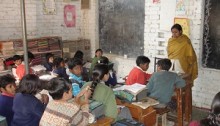
Our Schools
Forest officials and villagers heaved a sigh of relief on Monday as a female bear, which had entered the house of an elderly woman at a tribal village in the district on Thursday, was captured. The bear had stayed put in the house of Sambari Bhatra at Bodo Puria village under Borigumma block after delivering two cubs. The administration had shifted at least 69 panicked persons of 14 families to the village school on Thursday.

Communal Harmony
National Foundation for Communal Harmony (NFCH) was set up as an autonomous organisation under the Societies Registration Act, 1860, and registered on the 19th February, 1992 with the main objective of providing assistance for the physical and psychological rehabilitation of the child victims of communal, caste, ethnic or terrorist violence, with special reference to their care, education and training besides promoting communal harmony, fraternity and national integration. The Home Minister is ex-officio chairman of the Governing Council of the Foundation. The Governing Council decides broad policies, suggests measures for achieving its objectives and exercises overall supervision over the Foundation.
Nari Sashaktikaran Abhiyan
The former was a precarious freedom of women . He was placed on the screen and her upbringing was not entitled to . He could not take any decision for themselves . Before marriage and after marriage the husband ‘s father was his decision . Before marriage and after marriage laws parent compound was their life . But as – as people understood the meaning of freedom , women are supposed to be entitled to the freedom . Gradually improved his position . Education provided a new direction to his life . The area was now housebound but now they social , political , economic , there was Sdridh . Women’s empowerment begins from here . In all these areas the Priruson equate to strengthen its position and is known as empowerment .

Mahatma Gandhi NREGA at a Glance
The Mahatma Gandhi National Rural Employment Guarantee Act (MGNREGA) is an Indian law that aims to guarantee the ‘right to work’ and ensure livelihood security in rural areas by providing at least 100 days of guaranteed wage employment in a financial year to every household whose adult members volunteer to do unskilled manual work.The statute is hailed by the government as “the largest and most ambitious social security and public works programme in the world”. The more comprehensive survey of Comptroller and Auditor General (CAG) of India, a ‘Supreme Audit Institution’ defined in Article 148 of the Constitution of India, reports serious lapses in implementation of the act.

Our Occupation
Agriculture
Agriculture, also called farming or husbandry, is the cultivation of animals, plants, fungi, and other life forms for food, fiber, bio_fuel, drugs and other products used to sustain and enhance human life.Agriculture was the key development in the rise of sedentary human civilization, whereby farming of domesticated species created food surpluses that nurtured the development of civilization. The study of agriculture is known as agricultural science. The history of agriculture dates back thousands of years, and its development has been driven and defined by greatly different climates, cultures, and technologies. However, all farming generally relies on techniques to expand and maintain the lands that are suitable for raising domesticated species. For plants, this usually requires some form of irrigation, although there are methods of dry land farming. Livestock are raised in a combination of grassland-based and landless systems, in an industry that covers almost one-third of the world’s ice- and water-free area. In the developed world, industrial agriculture based on large-scale mono culture has become the dominant system of modern farming, although there is growing support for sustainable agriculture, including permaculture and organic agriculture.